Pale Indian Plantain (Arnoglussum atriplicifolium) often reaches eight feet in height and seldom flops. Strongly upright, the attractive purple stems support a smooth deep green foliage, with an almost rubbery texture, that looks great right up to the first frost.
Pale Indian Plantain (Arnoglussum atriplicifolium) often reaches eight feet in height and seldom flops. Strongly upright, the attractive purple stems support a smooth deep green foliage with an almost rubbery texture, and looks great right up to the first frost. In late summer the remarkable white flower torches attract an array of pollinators. Unique among prairie plants the flowers are pollinated almost exclusively by wasps and can be very useful for organic gardeners employing pest control with predatory insects.
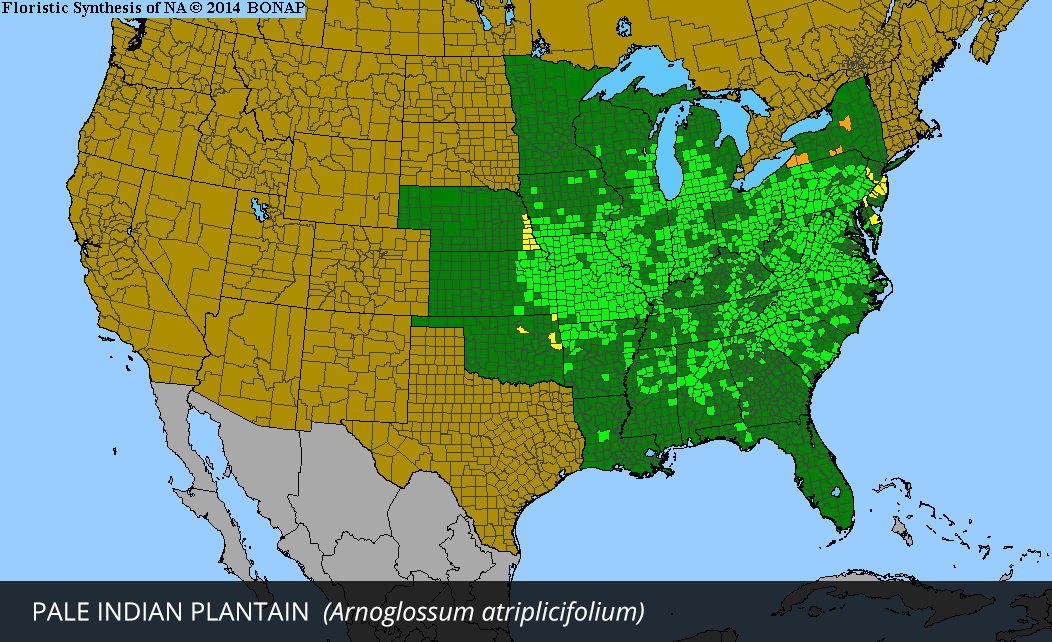
Native to tallgrass prairies, open woodlands, and riverbanks of the central and eastern U.S, Pale Indian Plantain thrives in a wide variety of conditions, from clay to sand, in full sun to partial shade. Medium to moist settings may be ideal, particularly with full sun, but drier sites are also well tolerated.
Pale Indian Plantain can spread via underground rhizomes and self-seeds readily, making it good choice for naturalized areas, or larger native landscapes. It provides a strong structural element in gardens and meadows, but may not be suitable for tight planting areas or formal borders.
Native plants can be grown outside of their native range in the appropriate growing conditions. This map shows the native range, as well as the introduced range, of this species.
Plant Shipping Rates: for plant orders up to $50 the shipping amount is $9.95. For plant orders from $50.01 and over, the shipping rate is 20% of the total plant cost.
Spring plant-shipping begins March 22, 2027. The last day to order plants this spring is projected to be May 14, 2027.
During checkout, you will choose a shipping week for your plant delivery, from the dates that are available. The week that you choose will be included in your order confirmation email. When your plants ship you will receive an email that includes your tracking information.
We ship plant orders Monday thru Wednesday from our nursery in central Wisconsin. The farther your plants need to travel, the earlier in the week they will ship. The goal is to deliver all plants by the end of the week.